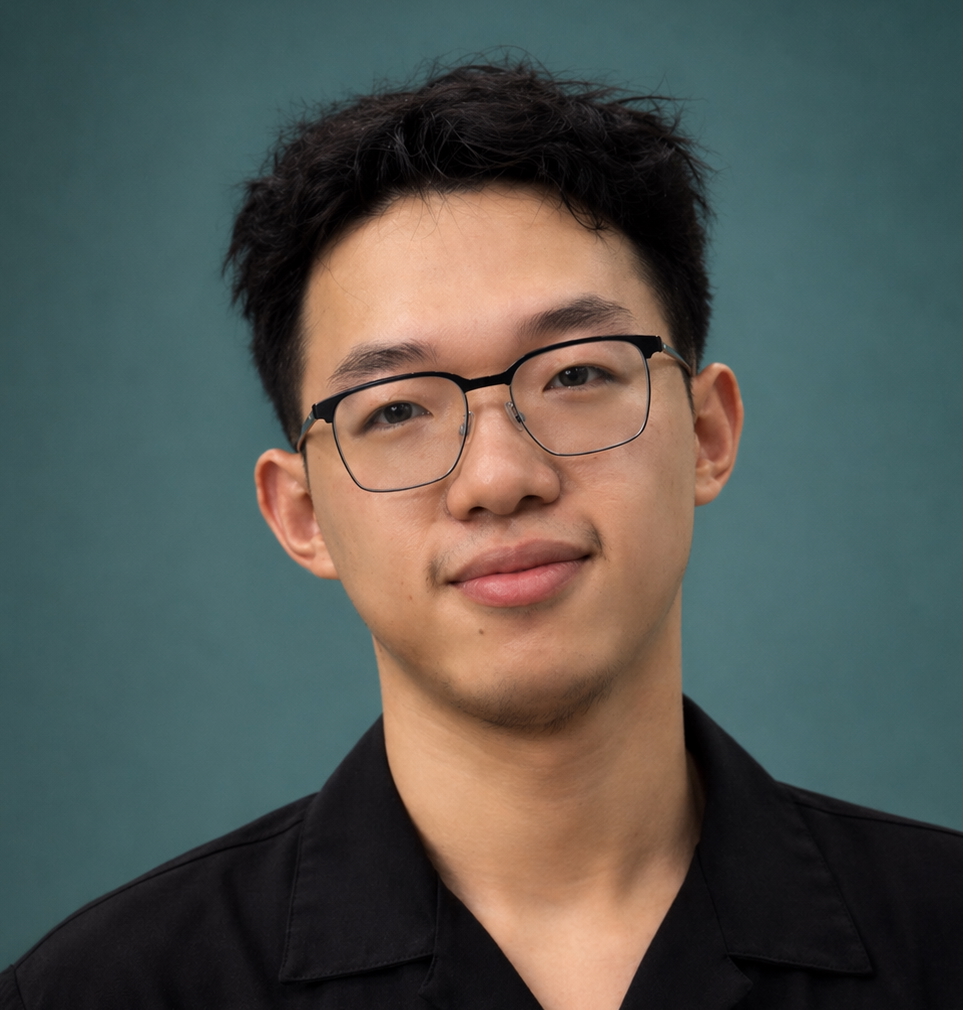
Researching how memory, language, and embodied AI come together — building conversational agents that remember, retrieve, and reason in immersive environments.
I'm a first-year PhD student at the University of Toronto, advised by Prof. Scott Sanner in the Data Driven & Decision Making (D3M) Lab.
My work sits at the intersection of natural language processing, recommender systems, and embodied AI. I build conversational agents that can hold structured memory, retrieve information from a user's lived experience, and reason about goals in the open world — with recent papers at ACL, ICLR, AAAI, EMNLP, and UMAP.
Before the PhD, I completed my MASc in Information Engineering at U of T and a BMath in Computational Mathematics at Waterloo. I'm a recipient of the Ontario Graduate Scholarship and the MIE Teaching Assistant Award.
How can recommenders ground themselves in multimodal context — scenes, dialogues, items — and respond to natural-language preferences?
Structured, addressable memory layers — knowledge graphs and semantic paths — that let agents recall, reason, and stay consistent across long horizons.
Retrieval inside immersive environments: in-situ item labels, scene grounding, and the user's first-person view as a query.
MIP and QPBO reductions for clustering and prediction problems, with a focus on near-optimal solutions in non-separable spaces.
ACL 2026
Work on scene-based in-situ item labeling, multimodal item scoring via Gaussian processes, and a Semantic XPath system demo — plus a Bayesian active-learning paper led by Junyoung Kim.
ICLR 2026
Lifting classical PDDL planning to natural-language predicates for open-world goal-oriented commonsense regression planning in embodied AI.
AAAI 2026
MIP and QPBO reductions for predictive clustering in non-separable spaces, with strong empirical gains over heuristic baselines.
Milestone
Continuing in the D3M Lab under Prof. Scott Sanner. Also awarded the Ontario Graduate Scholarship and a U of T Departmental Fellowship.
EMNLP 2025
A manifold-aware distance metric for dense passage retrieval that respects the local geometry of the embedding space.
Award
Recognized for graduate-level instruction in MIE223 (Data Science), MIE370 (ML), and MIE451 (Decision Support Systems).