Case Study Using the Optimal Temporal Clustering Framework
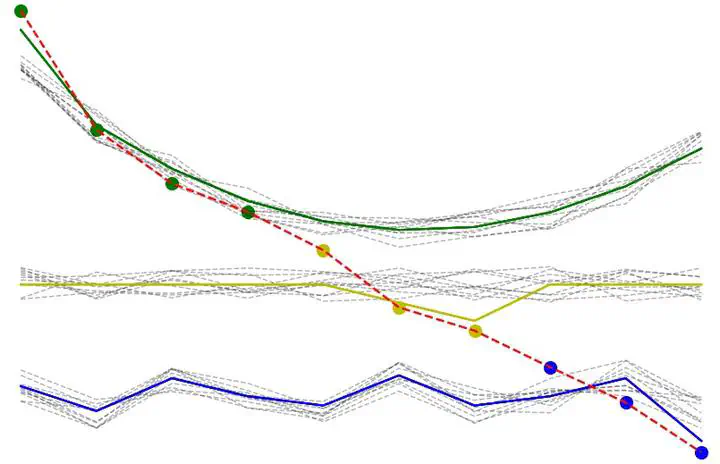
Clustering, a widely employed unsupervised machine-learning tool, has found applications spanning diverse disciplines. Temporal clustering, particularly the task of grouping unlabelled multivariate time-series data, has attracted considerable attention from researchers.
Jolomi Tosanwumi, a current Master of Applied Science student, has recently introduced a generalized framework for temporal clustering that effectively addresses two critical issues inherent in prior algorithms: (1) the incapacity to analyze cluster changes over time and (2) suboptimal outcomes arising from different initializations. In collaboration with Tosanwumi, this project undertook a comparative performance analysis of the newly proposed framework against existing algorithms using synthetic data.
Additionally, two case studies were conducted employing real-world census and climate temporal data to validate the efficacy of the proposed temporal clustering framework. The results of the case studies unveiled potential applications through analytical insights, including the discernment of coastal and inland cities using worldwide historical climate data, the revelation of a potential migration pattern in the workforce with occupations in art and culture in the city of Toronto, and the identification of two distinct trends in the rental market of Downtown Toronto.
Joe (Jiazhou) Liang
Data Scientist | Master Student @ University of Toronto
My research interests temporal clustering algorithms and its applications to solve real world problems.